
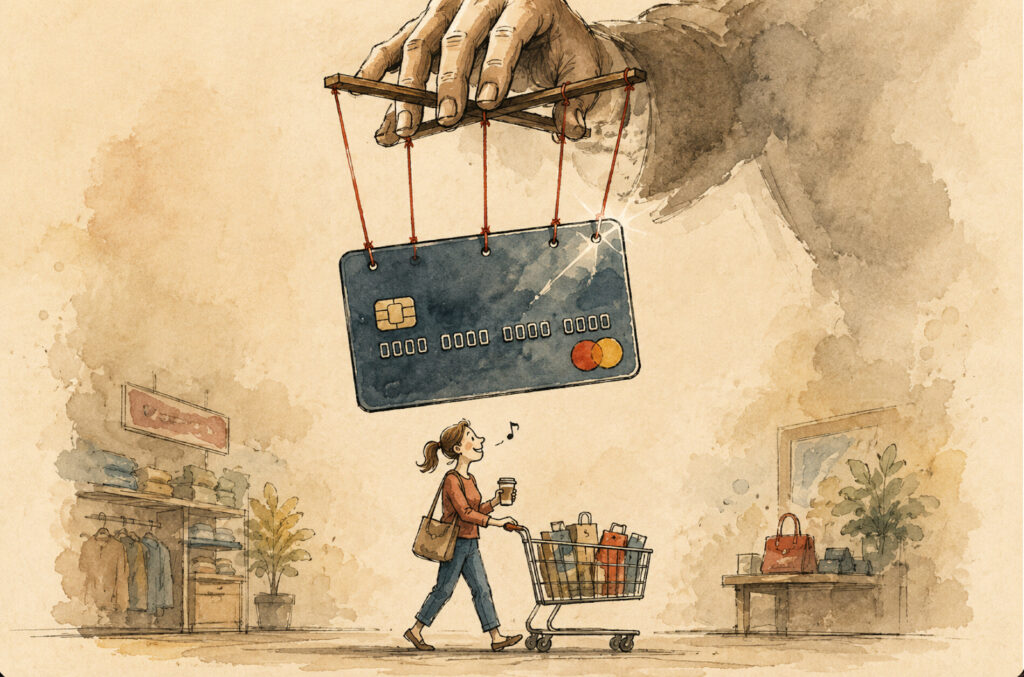
Have you ever noticed that using a credit card sometimes feels too easy? Tap, swipe, or click and you’re done. The purchase is made, the reward points are logged, and a notification pops up on your phone confirming the transaction before you’ve even put your wallet away.
Now think about what it feels like to try to pay that balance off. You have to log into an app that buries the payoff options, autopay defaults to the minimum payment, interest gets calculated in ways that aren’t exactly front and center and the due date moves around just enough to catch you off guard.
That difference isn’t accidental and it’s not a coincidence of design or an oversight in the user experience. It’s intentional. Credit card companies spend hundreds of millions of dollars every year making sure that spending is easy and that paying off the full balance is just inconvenient enough that most people don’t.
This article is going to walk through exactly how they do it. Not to make you angry, though some of this is genuinely worth being frustrated about, but because understanding the system is the first step toward not being controlled by it.
The Minimum Payment Default: The Most Expensive Button on Your Phone
Here’s a question worth considering. When you set up autopay on your credit card, what was the default setting?
For the vast majority of credit card issuers, the default autopay option is the minimum payment. It’s not the full balance or a fixed amount you choose. It’s the minimum. The smallest number the company can legally require you to pay while keeping your account in good standing.
This is a design decision. Someone at that company decided what the default should be, and they chose the option that generates the most interest revenue over time. Setting autopay to the minimum payment and forgetting about it is one of the fastest ways to spend years paying a credit card bill while barely reducing the balance.
The minimum payment is typically calculated as either a flat fee, usually around $25 to $35, or a small percentage of the balance, often 1 to 2 percent, whichever is greater. On a $10,000 balance at 22% interest, your minimum payment might be around $200. Of that $200, roughly $183 goes toward interest. Only about $17 reduces your actual balance. At that pace, paying off $10,000 takes decades and costs you more in interest than the original balance.
The credit card company knows this math better than anyone. They designed the minimum payment structure specifically to maximize the interest you pay over time. And then they made it the default.
The App Experience: Built for Spending, Not Paying
Open most credit card apps and notice what’s easy to find. It’s easy to find your available credit, rewards balance, recent transactions, offers and promotions and a big button to pay your bill, which takes you to a screen where the minimum payment is pre-filled.
Now…try to find your total interest paid this year, a projection of how long it’ll take to pay off your balance at your current payment amount or a clear breakdown of how much of your last payment went to interest versus principal.
That information exists but it’s buried. Getting to it usually requires navigating through multiple screens or, in some cases, calling customer service or reading your paper statement carefully. The information that would motivate you to pay more aggressively is not where your eyes naturally land when you open the app.
This isn’t an accident. It’s intentional information architecture. UX designers are paid specifically to think about where users’ eyes go, what they click first, and what decisions the app makes easy versus hard. The decision to make spending easy and payoff information invisible is a deliberate choice made by people who understand exactly what they’re doing.
Compare that to the experience of making a purchase. One-click checkout. Saved card information. Apple Pay, Google Pay, tap-to-pay. Every friction point in the spending experience has been systematically eliminated. Every friction point in the payoff experience has been carefully preserved.
Due Date Manipulation: The Calendar Trap
Credit card due dates are not fixed to a specific day of the month in the way most people assume. They can, and do, change, and the way they change is not always in the cardholder’s favor.
Most issuers set due dates around 21 to 25 days after the close of the billing cycle but the billing cycle close date can shift. Holidays, weekends, and other factors affect when statements generate and when payments are due. If you’re someone who pays your bill around the same time each month without checking the exact due date, it’s genuinely easy to be a day or two late without realizing it.
A single late payment triggers a late fee, typically $25 to $40. It can also trigger a penalty APR on some cards, which can push your interest rate into the 29 to 30 percent range. And it marks a 30-day late payment on your credit report if it goes far enough, which damages your score.
None of this is illegal. Issuers are required to provide notice of your due date and they do. But the system is structured in a way that makes accidental lateness easy and the consequences of that lateness significant and profitable.
It’s also worth noting that credit card companies are not required to set due dates at the most convenient time for you. Some issuers set due dates that land just before most people’s payday cycles. Whether that’s intentional is genuinely hard to prove. But the pattern is real and worth knowing about.
The Interest Calculation Method Nobody Explains
Ask most people how credit card interest is calculated and they’ll say something like “it’s your balance times the interest rate.” That’s roughly right but it misses a detail that costs people real money.
Most credit cards use average daily balance to calculate interest. That means interest accrues every single day based on the balance you carry that day, not just at the end of the billing cycle. If you make a large purchase on day one of your billing cycle, you’re paying interest on that balance for the full 30 days, not just the days remaining before the payment is due.
This also means that making your payment late in the billing cycle, even by a few days, costs you more in interest than making it early. The math on this is small on any individual transaction but adds up meaningfully over a year of carrying balances.
There’s also the grace period trap. Most cards offer a grace period where no interest accrues if you pay your full balance each month. But if you carry a balance from one month to the next, that grace period disappears entirely. New purchases start accruing interest immediately from the date of the transaction, not from the end of the billing cycle. A lot of people don’t know this until they’re confused about why their interest charge is higher than they expected.
Credit Limit Increases: A Generosity That Isn’t
At some point, most people with a credit card in good standing receive a notification. Your credit limit has been increased. It’s framed as a reward, recognition of your good payment history and a vote of confidence from the issuer.
Here’s what it actually is. A higher credit limit means you can carry a larger balance. A larger balance means more interest revenue for the issuer. Credit limit increases are not generosity. They’re a business decision designed to increase the amount of money you can potentially owe them.
There’s also a psychological dimension to this. Research on consumer spending consistently shows that people tend to spend closer to their credit limit over time. When that limit goes up, spending often follows. The issuer knows this. The limit increase isn’t random. It’s timed based on your spending patterns, your payment behavior, and a calculation of how much additional revenue they can generate by giving you more room to run.
This doesn’t mean you should refuse credit limit increases or that they’re never useful. A higher limit can actually help your credit score by reducing your utilization ratio if your balance stays the same. But understanding why the increase is being offered, and who it primarily benefits, changes how you relate to it.
Rewards Programs: The Tail That Wags the Dog
Rewards credit cards are one of the most effective marketing inventions in the history of consumer finance. The premise is straightforward. Spend money, earn points or cash back, get something in return. For people who pay their balance in full every month, rewards cards are genuinely valuable. You’re using the bank’s money interest-free and getting compensated for it.
For everyone else, they’re a trap dressed up as a benefit.
Rewards cards carry higher interest rates than standard cards, typically by two to four percentage points. The rewards program is funded partially by those higher rates and partially by interchange fees charged to merchants. When you’re carrying a balance on a rewards card at 26 percent interest, the cash back you’re earning is a small fraction of what the interest is costing you. You’re paying the bank significantly more than they’re giving you back.
But the psychological pull of the rewards program keeps people engaged. Watching points accumulate feels like progress. It creates a positive association with the card and with spending. That positive association is worth an enormous amount to the issuer because it keeps you using the card and keeps the balance growing.
The rewards program is also why people resist closing high-interest cards. They don’t want to lose their points or their status. The issuer has engineered a reason for you to stay even when staying is costing you money.
The Customer Service Script: Designed to Keep You Paying
If you’ve ever called a credit card company to ask about your options, you may have noticed that the conversation follows a pattern. They offer to lower your interest rate temporarily. They suggest a hardship program that reduces your minimum payment for a few months. They mention a balance transfer to one of their other products.
What they don’t mention is debt settlement. They don’t suggest that you might be able to pay significantly less than you owe. They don’t recommend nonprofit credit counseling. They don’t walk you through your legal rights as a borrower.
This isn’t because those options don’t exist. It’s because none of them benefit the credit card company. Every option they offer you during a customer service call is one that keeps the relationship intact and keeps you paying interest to them. The options that would actually reduce what you owe are conspicuously absent from the conversation.
Credit card customer service is not a resource for people struggling with debt. It’s a retention tool. Understanding that changes how you approach the conversation and where you look for actual solutions.
The Psychological Architecture of Debt
Beyond the specific mechanics, there’s a broader psychological system at work that’s worth understanding.
Credit card companies invest heavily in research on consumer behavior and decision-making. They know that people are more comfortable spending when the pain of payment is delayed. They know that digital transactions feel less real than cash. They know that small frequent charges feel less significant than large ones, which is partly why subscription services and small purchases are so easy to accumulate on a card without noticing.
They also know that debt is emotionally loaded. People who feel ashamed or overwhelmed by their debt tend to avoid looking at it. They stop opening statements. They stop checking balances. They make the minimum payment automatically and try not to think about it. That avoidance is profitable for the issuer because it keeps people on the minimum payment treadmill indefinitely.
The shame around debt isn’t accidental either. When people feel personally responsible for a situation that was substantially engineered by design choices they weren’t aware of, they’re less likely to look for structural solutions. They’re more likely to keep trying to solve the problem individually, with tools the credit card company is happy to offer them.
What You Can Actually Do About It
Understanding the system doesn’t automatically get you out of debt but it does change the frame. When you see the mechanics clearly, the idea of looking for solutions outside the system the credit card company controls starts to make a lot more sense.
A few things worth doing immediately, regardless of where you are in terms of balance.
Change your autopay setting right now if it’s set to the minimum payment. Set it to the full balance if you can, or to a fixed amount that’s meaningfully higher than the minimum. That one change, made once, puts you on a completely different trajectory than the default.
Find out how much interest you’ve paid in the last twelve months. This number is on your annual statement or available in your account history. For most people carrying significant balances, this number is genuinely shocking and does more to motivate change than any budgeting advice ever could.
Understand that the options the credit card company offers you are not the complete list of what’s available. Balance transfers, hardship programs, and temporary rate reductions are all things that keep you in a relationship with them. Debt settlement, which involves negotiating to pay less than you owe and closing the accounts, is something they have no incentive to tell you about because it ends the relationship on your terms rather than theirs.
For people carrying $15,000 or more in credit card debt, settlement is often the option that produces the most meaningful outcome in the shortest time. It’s not for every situation, and it comes with real trade-offs around credit score impact but for someone who’s been on the minimum payment treadmill for years and can see that the math isn’t working, it’s worth understanding what it actually involves before dismissing it.
The credit card company is not going to tell you about it. That’s the whole point.
The Bottom Line
Credit card companies are not financial wellness partners. They’re businesses. And like any business, the products and experiences they design are optimized for their revenue, not your financial health.
The frictionless spending experience. The minimum payment default. The buried payoff information. The limit increases. The rewards programs that keep you engaged. The customer service scripts that never mention the options that would actually help you most. None of it is accidental. All of it is intentional.
That doesn’t make you a victim. It makes you someone who now understands the game well enough to stop playing by their rules. And that’s a meaningfully different position to be in.
The first step is understanding exactly what’s been happening. You just did that. The next step is figuring out which options are actually available to you outside the system you’ve been in, and whether any of them produce a better outcome than what you’re currently on track for.
For a lot of people, the answer to that question changes everything.