
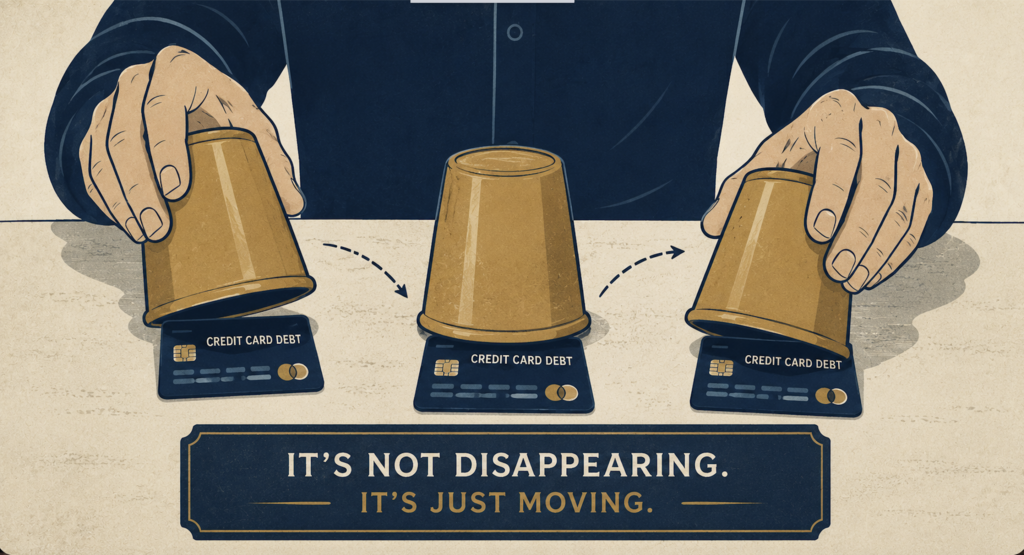
Balance transfers are one of those ideas that sounds almost too good. Move your high-interest credit card debt to a new card with zero percent interest for 12 to 21 months, stop paying interest, knock down the balance, and come out ahead. It’s a clean, logical plan. And the credit card companies market it aggressively, which means millions of people try it every year.
So does it actually work?
Sometimes. Under specific conditions, for a specific type of borrower, a balance transfer can genuinely help. But for a lot of people, especially those carrying balances above $10,000, it doesn’t solve the problem. It delays it. And in some cases it makes things quietly worse.
This article is going to walk through the actual math so you can decide for yourself whether a balance transfer makes sense for your situation, and what the alternatives look like if it doesn’t.
How Balance Transfers Actually Work
The basic mechanics are straightforward. You apply for a new credit card that offers a promotional zero percent APR on balance transfers for an introductory period, usually somewhere between 12 and 21 months. You transfer your existing balance to the new card. During the promotional window, no interest accrues on that transferred balance. You pay it down. At the end of the promotional period, whatever’s left gets hit with the card’s regular APR, which is typically somewhere between 19 and 29 percent.
That’s the deal. Interest-free time in exchange for moving your balance to a new card.
There are a few costs baked in that don’t always get front-page treatment. Most balance transfer cards charge a transfer fee of 3 to 5 percent of the amount transferred. On a $10,000 balance that’s $300 to $500 added to what you owe right off the bat. And that zero percent rate typically only applies to the transferred balance, not to new purchases. New purchases on the card often accrue interest immediately.
None of that disqualifies the strategy. But it’s worth understanding the full picture before running the numbers.
The Math When It Works
Let’s look at the best-case scenario first, because balance transfers do work for the right person.
Say you have $6,000 in credit card debt at 22% interest and you transfer it to a card with an 18-month zero percent promotional period and a 3% transfer fee.
That’s a real win. Nearly $1,800 saved, and the debt is completely gone in 18 months. If you can make that monthly payment consistently, don’t use the new card for anything else, and pay off the full balance before the promotional period ends, the balance transfer does exactly what it promises.
The operative words there are “if.” And for a lot of people, those conditions are harder to meet than they look on paper.
The Math When It Doesn’t
Now let’s look at what happens with a higher balance and a more realistic payment scenario. This is where most people actually live.
Say you have $18,000 in credit card debt spread across a couple of cards. You transfer it to a 0% card with a 21-month promotional period and a 3% transfer fee.
This is the version that doesn’t get advertised. You transferred the balance, paid down a portion of it, and then the promotional period ended with a significant chunk still sitting there. Now you’re back to paying high interest on a balance that’s only slightly smaller than where you started, plus you paid the transfer fee on top of it.
And if you used the new card for any purchases during those 21 months, those likely accrued interest the whole time, making the real balance higher than the transferred amount.
The reality check:
To pay off $18,540 in 21 months you need to pay $883 every single month without missing one. If your budget allowed for that, you probably wouldn’t be carrying $18,000 in credit card debt in the first place.
The Three Hidden Traps
Beyond the math, there are behavioral patterns that derail balance transfers more often than people expect. None of these are character flaws. They’re just worth knowing about before you commit to the strategy.
Trap 1: The freed-up card problem
When you transfer a balance off your existing cards, those cards now have available credit again. For a lot of people, that available credit doesn’t stay empty for long. Life happens. An unexpected expense shows up and the card is right there. Before the promotional period is even halfway over, the old cards have new balances and the total debt is higher than when you started. Studies consistently show this is one of the most common outcomes of balance transfers for people carrying significant debt.
Trap 2: The qualification gap
The zero percent balance transfer cards with the longest promotional periods are reserved for people with good to excellent credit. If your score has taken hits from high utilization or any missed payments, you may not qualify for the best offers. The card you actually get approved for might have a shorter promotional window, a higher transfer fee, or both. The math changes significantly when you’re working with 12 months instead of 21.
Trap 3: The false finish line
This one is psychological. Getting approved for a balance transfer can feel like progress. The balance moved. The interest stopped. Something happened. That sense of progress sometimes reduces the urgency that was driving the payments in the first place. Eighteen months later, the balance is still there and the promotional period is ending.
Who a Balance Transfer Actually Makes Sense For
It’s worth being fair here. Balance transfers are a legitimate tool for a specific type of borrower, and dismissing them entirely would be misleading.
A balance transfer makes the most sense if your total balance is low enough that you can realistically pay it off within the promotional period with your current income. A general rule of thumb: take the total balance including the transfer fee and divide it by the number of promotional months. If that monthly number fits comfortably in your budget with room to spare, the strategy can work well.
It also helps if your credit score is strong enough to qualify for the best promotional offers, if you have the discipline to leave the freed-up cards alone, and if you don’t have a history of the debt coming back after previous payoff attempts.
If all of those things are true, a balance transfer can save you a meaningful amount of money and get you to zero faster. That’s a real outcome worth pursuing.
But if your total debt is significantly higher than what you can pay off in 18 to 21 months, or if you’ve been down this road before and the balance found its way back, the balance transfer isn’t solving your problem. It’s buying you time. And time alone doesn’t change the math.
What the Math Looks Like for Higher Balances
Let’s run one more scenario. This time with $25,000 in credit card debt, which is closer to what a lot of people are actually carrying.
You paid $750 to transfer. You paid down about half the balance during the promotional period. And now you’re four or five years into this with thousands more in interest still ahead of you. The balance transfer helped a little. It didn’t solve the problem.
Now compare that to what debt settlement looks like on a $25,000 balance. A settlement program typically negotiates the principal balance down, often to somewhere between 40 and 60 cents on the dollar. If you settle $25,000 for 50 cents on the dollar, you’re paying $12,500 to resolve the debt entirely, typically over 24 months or less. No transfer fee. No promotional period that expires. No back-end interest rate waiting to kick in.
The credit score impact is real and shouldn’t be minimized. But on a purely mathematical basis, for someone carrying $20,000 or more in credit card debt, settlement frequently results in less total money out of pocket and a faster path to zero than a balance transfer ever could.
The Question Worth Asking Yourself
Before deciding whether a balance transfer is the right move, it helps to answer a few honest questions.
First, what’s your total balance across all cards, including any you’re thinking about transferring? Not a rough estimate. The actual number.
Second, what’s a realistic monthly payment you can make consistently, not the number you could make in a perfect month, but the number you can commit to every single month for the next 18 to 21 months?
Third, does that monthly payment, multiplied by the promotional period, actually cover the full balance including the transfer fee? If the answer is no, the promotional period ends with a balance. And you need a plan for that balance before you start.
And finally, have you tried to pay down this debt before? What happened? If the balance has come back before after previous attempts, a balance transfer addresses the symptom but not the pattern.
None of these questions are meant to talk you out of anything. They’re meant to help you make a decision based on your actual numbers rather than the best-case version of the plan.
The Bottom Line
A balance transfer is a useful tool with a narrow window of effectiveness. For borrowers with manageable balances, strong credit, and the cash flow to pay it off within the promotional period, it can save real money.
For people carrying $15,000, $20,000, or $30,000 in credit card debt, it’s more likely to delay the problem than solve it. The math just doesn’t work at those levels unless your monthly payment capacity is unusually high relative to the balance.
The credit card companies offering these promotions know the math too. They know that a meaningful percentage of people who do balance transfers won’t pay off the full amount before the promotional period ends. That’s part of the business model. The promotional offer gets you in the door. The regular APR is what makes it profitable.
Understanding that doesn’t make balance transfers bad. It just puts them in the right context. They’re a product designed to benefit the issuer as often as they benefit the borrower. Whether they benefit you specifically comes down to your numbers, not the marketing.
If you’ve run your numbers honestly and the balance transfer math doesn’t add up, it’s worth understanding what other options actually look like. For people with significant credit card debt who want an actual reduction rather than a temporary pause on interest, there are programs designed to do exactly that, without a new loan and without a promotional period that expires.