
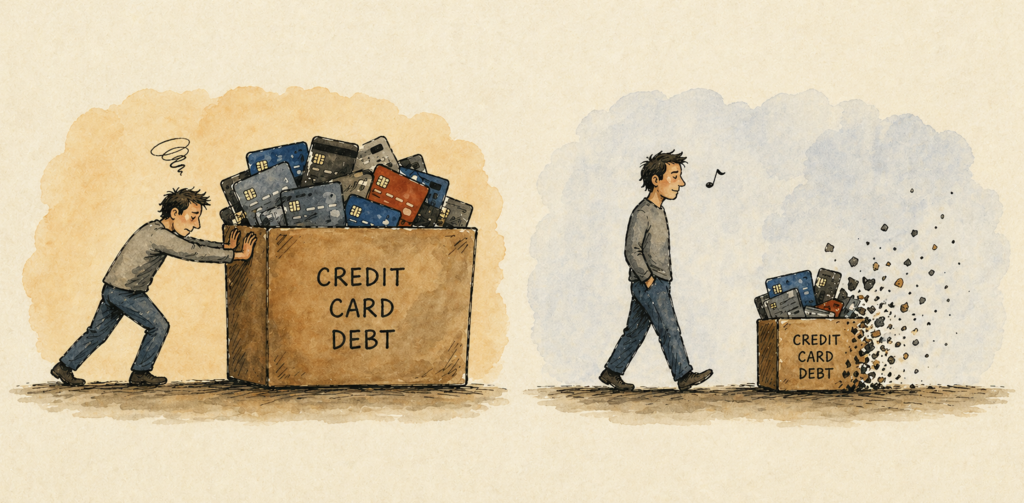
If you’ve been researching ways to get out of credit card debt, you’ve probably run into both of these terms. Debt consolidation. Debt settlement. They sound similar. They’re often mentioned in the same breath. And if you’re not careful, it’s easy to assume they’re basically the same thing with different names.
They’re not. They work very differently, they produce very different results, and for most people carrying serious credit card debt, one of them is a significantly better option than the other.
This article is going to break down exactly how each one works, who each one actually makes sense for, and which one tends to get people out of debt faster. No sales pitch. Just a straight comparison so you can make an informed decision.
What Debt Consolidation Actually Is
Debt consolidation means taking multiple debts and combining them into a single new loan, usually with the goal of getting a lower interest rate or a more manageable monthly payment.
The most common versions are a personal loan used to pay off credit card balances, a balance transfer to a new card with a low or zero percent introductory rate, or a home equity loan or line of credit used to pay off unsecured debt.
Here’s the key thing to understand about consolidation: it doesn’t reduce what you owe. You’re borrowing money to pay off other money you borrowed. The total debt stays the same. What changes is where you owe it and, ideally, at what interest rate.
In the right circumstances, that actually helps. If you qualify for a significantly lower interest rate, more of your monthly payment goes toward principal instead of interest, and you pay it off faster. That’s the version of consolidation that works.
The version that doesn’t work is when people consolidate, free up the credit cards they just paid off, and run the balances back up. It happens more often than most people want to admit. And if the new loan rate isn’t meaningfully lower than what you were paying before, you may just be moving the problem around with a longer repayment timeline attached to it.
Who consolidation tends to work for:
People with good enough credit to qualify for a low-rate personal loan or balance transfer, who have a manageable total debt load relative to their income, and who are confident they won’t accumulate new balances in the process.
What Debt Settlement Actually Is
Debt settlement works completely differently. Instead of taking out a new loan to cover what you owe, settlement involves negotiating with creditors to accept less than the full balance as payment in full.
Not a lower interest rate. Not a restructured payment plan. An actual reduction in the principal balance you owe.
If you owe $22,000 in credit card debt and settle for 50 cents on the dollar, you pay $11,000 and the rest is gone. That’s how it’s supposed to work, and when it works, it’s a genuinely different outcome than anything consolidation can offer.
Settlement typically happens after accounts have become delinquent, because that’s when creditors are most motivated to negotiate. A creditor who thinks they might get nothing is far more willing to take something than a creditor who expects you to keep making payments indefinitely. That’s the leverage settlement uses.
The tradeoff is real. Your credit takes damage during the process. The forgiven amount may be treated as taxable income depending on your situation. And not every creditor will settle, at least not for the same terms.
Most people who go through settlement do it with the help of a professional program rather than negotiating directly with creditors themselves. The programs know what creditors typically accept, which ones negotiate and which ones don’t, and how to structure the process to get the best outcome.
Who settlement tends to work for:
People with $10,000 or more in unsecured credit card debt who are already behind or struggling to keep up, whose credit score is already suffering, and who want to actually reduce what they owe rather than just reorganize it.
Side by Side: The Honest Comparison
Factor Consolidation Settlement
What happens to your balance Stays the same, just moved to a new loan Reduced — you pay less than you owe
Credit requirement Good credit usually required Works even with damaged credit
Credit score impact Minimal if managed well Significant during the process, recovers over time
New debt involved Yes — you’re taking out a new loan No — no new loans or borrowing
Typical timeline 2 to 7 years depending on loan 24 to 48 months for most programs
terms
Total amount paid Full balance plus interest on new loan A negotiated portion of the original balance
Best for Good credit, manageable debt load Higher balances, already struggling, want actual
reduction
The Speed Question: Which One Gets You Out Faster?
This is where it gets interesting, because the answer isn’t as simple as it looks on a comparison chart.
On paper, a consolidation loan might have a five-year repayment term and a settlement program might take two
to three years. Settlement looks faster. But that comparison assumes you qualify for a consolidation loan in the first place, which requires reasonably good credit and a debt-to-income ratio that works in your favor.
For a lot of people carrying significant credit card balances, that’s not the situation they’re in. Their credit has already taken hits from high utilization or missed payments. Their income doesn’t support the monthly payment a consolidation loan would require. The consolidation option that looks good on a comparison chart simply isn’t available to them.
Settlement, on the other hand, is often most accessible to people whose financial picture is already strained. The worse your situation looks to a creditor, the more motivated they are to settle. That’s counterintuitive, but it’s how the leverage works.
So in practice, for someone with $15,000 to $50,000 in credit card debt who’s already struggling, settlement frequently gets them to a zero balance faster than consolidation would, assuming consolidation is even an option for them at all.
There’s also the total cost to consider. Even if a consolidation loan has a lower interest rate than your current cards, you’re still paying back every dollar you borrowed plus interest. Settlement means you may only pay back 40 to 60 percent of what you owe. The math on total dollars out of pocket often favors settlement significantly, even accounting for fees.
The Credit Score Trade-Off
This is the part that makes a lot of people hesitate about settlement, and it’s worth being direct about it.
Going through a debt settlement program will hurt your credit score. Accounts become delinquent during the process. Settled accounts show up differently on your credit report than paid-in-full accounts. This is real and it matters.
But here’s the question worth considering: if you’re carrying $20,000 or $30,000 in high-interest credit card debt and making minimum payments, what’s your credit score doing right now? High utilization already drags it down. Any missed payments have already done damage.
The pristine credit score you’re protecting may not be as intact as you think.
More importantly, credit scores recover. People who complete settlement programs and come out with no remaining balances typically see their scores start rebounding within a year or two. The negative marks fade over time. A settled account seven years from now is ancient history. Carrying $25,000 in credit card debt for the next decade while paying thousands in interest is a much longer and more expensive problem.
A lower credit score for a few years is a short-term cost. Paying the full balance plus interest on debt you could have settled for less is a long-term one. They’re not the same kind of problem.
When Consolidation Is the Right Call
Settlement isn’t the right answer for everyone.
Consolidation makes genuine sense in specific situations, and it’s worth being honest about that.
If your credit is in good shape and you qualify for a personal loan at a meaningfully lower rate than your current cards, consolidation can save you real money and simplify your payments without the credit score impact of settlement. That’s a legitimate win.
If your total debt is relatively low, say under $10,000, and you have the income to pay it off within a few years, a
balance transfer to a zero-interest card or a short-term personal loan may be all you need. Not every debt situation requires settlement.
If you own a home with equity, a home equity loan can carry a very low interest rate compared to credit cards. The risk there is that you’re converting unsecured debt to secured debt backed by your house. That’s a trade-off worth understanding clearly before going that route.
The honest answer is that consolidation works well for people who have decent credit and a manageable debt load, and settlement works better for people who are already in deeper water. Neither is universally better. The right one depends on where you actually are.
How to Think About Your Own Situation
Here are a few honest questions worth asking yourself before deciding which direction makes sense.
First, do you actually qualify for a consolidation loan at a rate that’s meaningfully lower than what you’re currently paying? It sounds obvious, but a lot of people assume they’ll qualify and then find out the rate they’re offered isn’t much better than what they have. If the math doesn’t work, the option doesn’t work.
Second, what’s your realistic monthly budget for debt repayment? Consolidation requires consistent payments over a multi-year loan term. Settlement programs typically involve building up funds over time before negotiations happen. Your monthly cash flow matters for both.
Third, is the goal to protect your credit score or to get out of debt as fast as possible? Those aren’t always compatible objectives. Being clear about which one matters more right now shapes which option makes more sense.
And finally, how much do you actually owe, and how long will it realistically take to pay it off at your current pace? Running that number honestly, including the interest that keeps accruing, has a way of making the decision a lot clearer.
The Bottom Line
Debt consolidation is a reorganization tool. It can lower your interest rate and simplify your payments, but it doesn’t reduce what you owe. For the right person in the right situation, it works well.
Debt settlement is a reduction tool. It’s designed to get the actual balance knocked down, not just moved around. It costs you credit score points in the short term. But for someone carrying significant credit card debt who wants to actually get out rather than just restructure, it often gets them there faster and for less total money out of pocket.
Neither option is magic. But one of them is probably a better fit for where you are right now than the other. The most important thing is understanding the difference clearly before you commit to either path.