
Most people don’t end up in a debt crisis overnight. It doesn’t usually start with a single catastrophic decision or one terrible month. It starts quietly. Gradually. With small shifts that feel manageable in the moment but are actually early signals that something bigger is building under the surface.
The problem is that those signals are easy to rationalize. You tell yourself it’s temporary. That you’ll catch up next month. That everyone deals with this. And sometimes that’s true. But sometimes those quiet signs are telling you something important, and the longer you wait to listen, the fewer options you have when things get harder to ignore.
This isn’t a scare piece. It’s a checklist. Run through it honestly. If a few of these sound familiar, it doesn’t mean you’re in crisis. It means you’re in the window where doing something about it is still relatively straightforward.
Sign 1: You’re Not Sure How Much You Actually Owe
This one catches people off guard because it doesn’t feel like a warning sign. It just feels like being busy. But when you can’t tell someone your total credit card balance off the top of your head, or worse, when you actively avoid looking at it, that avoidance is doing real work.
People who are comfortably managing debt know their numbers. People who are starting to lose control of it often stop looking. It’s a psychological defense mechanism, and it’s completely understandable but not knowing what you owe doesn’t make the amount smaller. It just makes it harder to do anything about it.
If your honest answer to “how much credit card debt do you have?” is somewhere between “I’m not sure” and “I don’t want to think about it,” that’s the first sign worth paying attention to.
Sign 2: Your Minimum Payments Keep Creeping Up
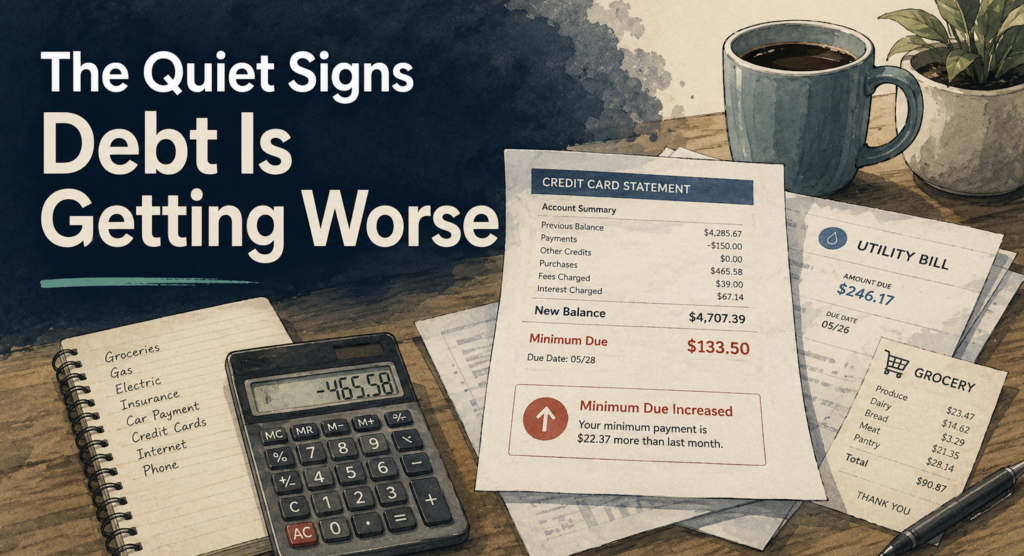
Minimum payments are calculated as a percentage of your balance. As your balance grows, so does the minimum. So if you’ve noticed that your required monthly payments are higher than they were a year ago even though you’ve been paying consistently, your balances aren’t going down. They’re going up.
That might seem obvious, but a lot of people miss it because they’re focused on making the payment, not on what the payment amount is telling them. Rising minimums are a quiet signal that interest is outpacing your payments. You’re on the treadmill and the speed is increasing.
The math on this is genuinely painful to look at. On a
$10,000 balance at 22% interest, making only minimum payments means you’ll pay somewhere around $12,000 in interest before the balance is gone, and it’ll take over 25 years to get there. Most people don’t realize they’re on that timeline until they actually run the numbers.
Sign 3: You’re Using Credit to Cover Things You Used to Pay With Cash
There’s a difference between using a credit card for convenience and using it because you don’t have another option. Most people know which one they’re doing, even if they don’t say it out loud.
When credit cards start filling gaps that used to be covered by income, groceries, gas, utilities, recurring bills, that’s a structural shift. It means your monthly expenses have outgrown your monthly income, and debt is quietly making up the difference. Every month that gap exists, the balance grows a little more.
This pattern is one of the fastest ways debt can accelerate. It’s not dramatic. It doesn’t feel like a crisis. It just feels like Tuesday. But six months of floating $400 a month in everyday expenses on a card at 24% interest adds up to a balance problem that can take years to unwind.
Sign 4: You’ve Started Robbing Peter to Pay Paul
You know the pattern. Pay the minimum on card A because you need to put more toward card B this month. Float a bill for a few days because payday is close. Move money between accounts to make sure the right things clear in the right order.
Managing your finances this way isn’t always a sign of crisis. Plenty of people do it occasionally and it’s fine. But if it’s become your normal operating mode, if every month involves a small juggling act just to keep things from falling apart, that’s a sign the margin in your budget has disappeared.
When there’s no cushion, any unexpected expense becomes a crisis. A car repair, a medical bill, a slow week of income. Without margin, those things don’t just cause stress, they cause new debt. And new debt makes the juggling harder next month.
Sign 5: You’ve Stopped Thinking About the Future and Started Just Surviving the Month
This one is less about numbers and more about mindset, but it’s one of the most telling signs of all.
When debt is manageable, people think in longer time horizons. They save for things. They plan ahead. When debt starts to take over, the mental energy required to manage it month to month crowds out everything else. You stop thinking about vacations, retirement, or even just a cushion in savings. You’re just trying to get to the end of the month in one piece.
That mental shift matters for a few reasons. It makes it harder to see solutions because you’re too focused on immediate survival. It increases stress, which affects sleep, relationships, and decision-making. And it tends to keep people stuck in reactive mode rather than making proactive choices that could actually change the situation.
If you’ve noticed that your financial thinking has shrunk to a 30-day window, that’s worth taking seriously.
Sign 6: Your Debt Has Followed You Through Multiple “Fresh Starts”
A lot of people have a moment where they got serious about debt. They made a plan. Maybe they consolidated. Maybe they cut up the cards. Maybe they committed to paying more than the minimum every month. And for a while, it worked.
Then life happened. An unexpected expense. A change in income. A slow few months. And the balance crept back up.
If this cycle sounds familiar, it’s not a willpower problem. It’s a structural problem. The tools most people use to manage debt, budgeting harder, paying a little extra each month, consolidating into a new loan, are designed to work when the debt load is manageable relative to income. When it’s not, those tools slow the bleeding but don’t stop it. The balance always finds a way to come back.
Recognizing that you’ve been here before, more than once, is actually useful information. It means the approach needs to change, not just the effort level.
Sign 7: You’re Losing Sleep Over It
This one sounds obvious, but it’s worth naming directly because a lot of people normalize debt stress to the point where they stop recognizing it as a signal.
Lying awake running numbers. Feeling a knot in your stomach when the phone rings from an unknown number. Dreading looking at your bank account. Getting irritable or anxious in conversations about money. These aren’t just stress responses. They’re your nervous system telling you that the situation has crossed a line from uncomfortable to unsustainable.
Financial stress is one of the leading causes of sleep problems, relationship strain, and chronic anxiety. It compounds over time just like interest does. And just like interest, the longer it goes unaddressed, the more expensive it gets in ways that have nothing to do with dollars.
Sign 8: The Numbers Don’t Work Anymore, Even on Paper
Sometimes people reach the point where even the most optimistic version of the plan doesn’t add up. You sit down, run the numbers honestly, and realize that even if you stuck to the budget perfectly and nothing unexpected happened, you’d still be carrying significant debt five or ten years from now.
That’s not a motivation problem. That’s a math problem. And math problems don’t respond to trying harder. They respond to changing the equation.
When the realistic path forward involves paying thousands of dollars in interest over many years just to stay even, the question worth asking isn’t “how do I stick to the plan better?” It’s “is this the right plan?”
So What Do You Actually Do With This Information?
If you read through that list and recognized yourself in three or four of those signs, that’s not a reason to panic. It’s a reason to pay attention.
The window where debt is still solvable without serious consequences is longer than most people think, but it isn’t unlimited. The earlier you address it, the more options you have and the less it costs you, in dollars, in stress, and in time.
Most people in this situation have tried the standard approaches already. Budgeting more carefully. Paying a little extra when they can. Consolidating into a lower-rate loan. Those tools work in the right circumstances. But if you’ve tried them and the balance keeps climbing, or if the math genuinely doesn’t work no matter how you run it, it’s worth understanding what other options actually look like.
Debt settlement isn’t right for every situation. But for people carrying $15,000 or more in credit card debt who are already feeling the pressure, it’s an option that a lot of people don’t seriously consider until later than they should. The way it works is straightforward: rather than reorganizing what you owe or taking out a new loan, a settlement program negotiates to reduce the actual balance, then helps you pay off that reduced amount, often in 24 months or less.
No new loans. No reshuffling. An actual reduction in what you owe.
If any of the signs above hit close to home, the most useful thing you can do right now is get an honest look at what your options actually are. Not to commit to anything, just to understand what’s available before the window gets smaller.